
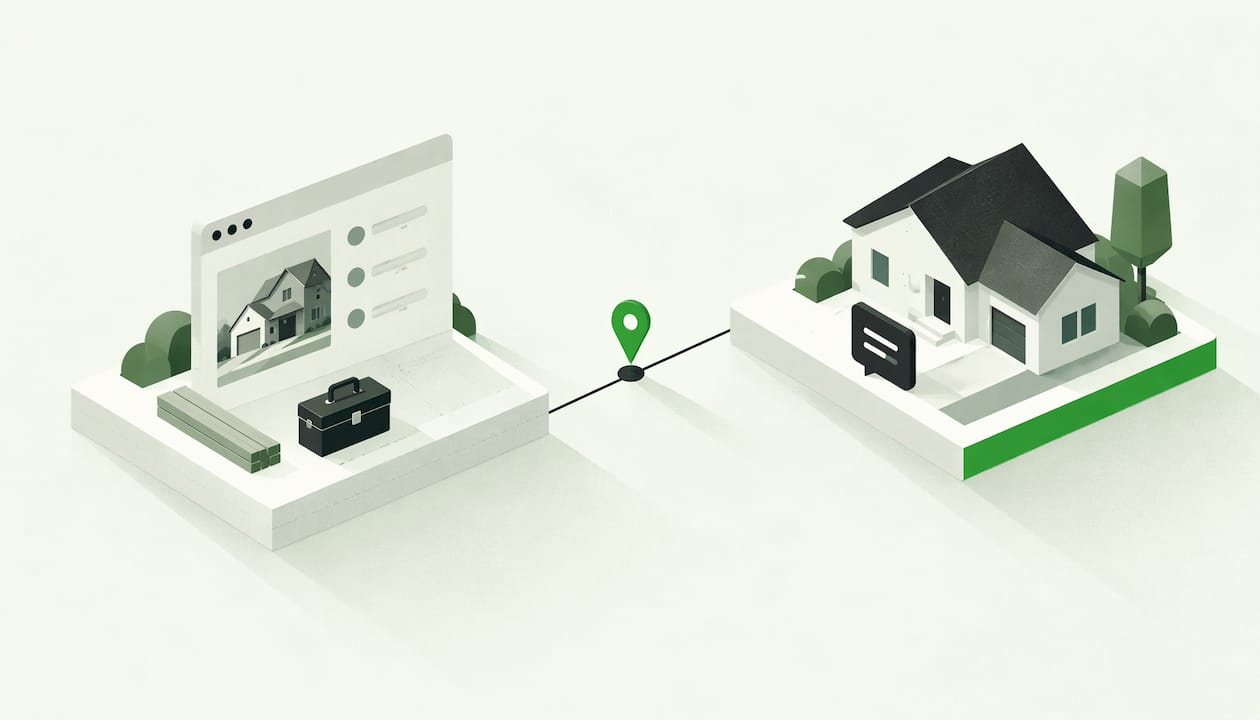
Roanoke contractors get more leads online by doing five things well. Claim and complete a Google Business Profile. Build a separate page for each service and each city you work in. Collect reviews steadily. Run a mobile site that makes calling effortless. Track which of these produces calls. Do that and homeowners find you first and phone you directly, instead of you paying to share a lead with four other bidders.
This guide walks through each piece in the order that pays off fastest, with what it costs and what to measure.
TL;DR
- Start with your Google Business Profile. Local rankings rest on relevance, distance and prominence, and the profile is where all three show up.
- Give every service and every city you actually serve its own page, with a clear call button.
- Reviews are the trust signal homeowners check next. Ask every happy customer and reply to every review.
- Shared leads get expensive fast. Direct calls from your own site cost you nothing per lead.
- Track calls by source every month, so you spend time on what works.
Table of Contents
- Where Roanoke homeowners look before they call
- Step 1: Build a Google Business Profile that wins the map
- Step 2: Give every service and every city its own page
- Step 3: Make reviews a weekly habit
- Step 4: Turn mobile visitors into phone calls
- Direct leads vs. shared leads
- Step 5: Qualify the inquiries you get
- Step 6: Track what produces calls
- Our perspective
- What it costs to build this with us
- A 30-day plan to get started
- FAQ
- Sources
Where Roanoke homeowners look before they call
A homeowner with a leaking roof or a dead furnace does not browse. They search, usually on a phone, and they pick from what appears first. In Roanoke that means the map results at the top of Google, then the organic listings, then a quick check of reviews.
Google is a big part of that picture. Google's own 2026 playbook says that in 2024 its profiles drove more than 2 billion direct connections every month, meaning calls, direction requests, messages, bookings and reviews, across more than 19 million American businesses. Your competitors across the valley are in that pool. The question is whether your profile and your site look like the obvious choice.
You have three ways to be found:
- The map pack. Driven by your Google Business Profile.
- Organic search. Driven by your website's service and city pages.
- Paid and directory leads. Fast, but you rent them, and often share them.
The first two compound over time. The third stops the day you stop paying. That is why most of this article is about the first two.
Step 1: Build a Google Business Profile that wins the map
Google states that local results are based mainly on relevance, distance and prominence. Relevance is how well your profile matches the search. Distance is how far you are from the searcher. Prominence is how well known you are, based on things like website links and the number of reviews.
You can't move Roanoke closer to yourself, but you control the other two. Here is a checklist:
- Claim the profile and verify it.
- Pick the right primary category. A roofer should choose roofing contractor, not a generic "contractor."
- List every service you actually perform, one by one.
- Set your service area to the places you really work: Roanoke, Salem, Vinton, and so on.
- Keep your name, address and phone number identical everywhere they appear online.
- Add real photos of finished jobs, your truck and your crew.
- Link to the right page. Point the profile at your site's homepage or the matching service page.
Google also reports that 29% of customers are more likely to consider a business with a detailed profile. A half-finished profile is leaving that on the table.
If your business is not showing up at all, our guide on why your service business isn't ranking in Roanoke lays out a three-step fix. If you want to compare software that helps you monitor your listing, see our roundup of local SEO tools for Roanoke small businesses.
Step 2: Give every service and every city its own page
One page that says "we do roofing, siding, gutters, windows and decks in the Roanoke area" is too vague to rank for anything. Search Engine Land's contractor SEO guide recommends separate pages for each service and dedicated pages for each city you genuinely serve, with the right keywords in titles, headings, URLs and page copy.
For a Roanoke contractor, that looks like this:
| Page type | Example | What it answers |
|---|---|---|
| Service page | Roof Replacement | What you do, how it works, what it costs to start |
| Service plus city | Roof Replacement in Roanoke, VA | "Who does this near me?" |
| Nearby city | Siding in Salem, VA | Same question for a town you serve |
| Proof page | Recent Roanoke projects | "Can I trust you?" |
A good city page is not the same page with a different town name swapped in. Mention neighborhoods you have worked in, the kinds of homes there, the local permit or weather issues you deal with, a few real photos and a customer comment. End each page with a clear action: a tap-to-call button and a short estimate form.
Only build a page for a place you actually serve. Thin, copied pages do not help you, and a homeowner who sees one loses trust instantly.
Our service area page blueprint shows the exact sections to include, and the local conversion website structure covers which pages a small contractor site really needs and which it can skip.
Step 3: Make reviews a weekly habit
Reviews do two jobs. They feed prominence in Google's ranking, and they are what a homeowner reads right before deciding to call. Google's playbook cites a consumer survey saying 91% of consumers use reviews to evaluate local businesses, and 65% say they are more likely to choose a business that responds to reviews.
That second number is the cheap win. Replying takes two minutes. Thank people by name, mention the job, and keep any complaint reply calm and factual.
What works in practice:
- Ask at the moment of peak happiness. When you finish a job and the customer is pleased, ask right then.
- Make it a one-tap task. Send a direct link to your Google review form by text, or hand over a card with a QR code. You can make one with our free Google review QR code generator.
- Ask every customer, every time. Steady is better than a burst of ten reviews in one week followed by silence. That steady pace is what we mean by review velocity.
- Reply to everything, good and bad.
Step 4: Turn mobile visitors into phone calls
Most of your visitors arrive on a phone, often in a hurry. Your site has a few seconds to show them three things: you do the job they need, you work in their area, and here is how to reach you.
A call-ready contractor site has:
- A tap-to-call button at the top of every page and fixed in view as the visitor scrolls.
- Your service area stated plainly near the top, such as "Serving Roanoke, Salem, Vinton and Roanoke County."
- A short form with only what you need: name, phone, what the job is. Every extra field costs you inquiries.
- Proof near the call button: review stars, a few photos of real work, license and insurance details if you hold them.
- Fast loading. A slow page loses people before they read a word. Our piece on the 10-second bounce threshold explains why.
- Real photos of your crew and projects, not generic stock images.
The path from search to phone call should take seconds, not minutes. See our friction-free funnel guide for how to cut each step. For a broader look at layout, read what gets a home service website's phone ringing, and for a checklist, how to get more calls from your business website.
Direct leads vs. shared leads
Some contractors lean on lead marketplaces and directory sites because they deliver something quickly. The catch is the math. An industry piece on shared versus exclusive leads gives a simple example: paying $100 per lead and closing one in five works out to $500 per job, before you count the time spent quoting.
Add the other costs that don't show on an invoice:
- You are bidding against several other contractors on the same inquiry.
- The homeowner is often shopping on price alone.
- You don't own the relationship, the listing or the reviews.
- When you stop paying, the leads stop.
A call that comes from your own Google profile or your own website is different. The homeowner chose you after reading your reviews and seeing your work. Nobody else got the same phone call. That is why we build for direct inbound calls. If you are weighing it up, read why to stop relying on directories and lead marketplaces.
This doesn't mean you must drop every paid channel overnight. It means your own assets, the profile, the site and the reviews, should be the foundation, so paid channels become optional rather than essential.
Step 5: Qualify the inquiries you get
More leads is only useful if the right ones come through. Not every caller is a good job, and treating them all the same burns your week.
A simple way to sort them is to ask about four things: budget, who makes the decision, what the actual need is, and the timeline. JobTread's guidance on construction leads uses the same logic, and notes that a realistic budget, a decision-maker on the line and a defined start window signal a stronger opportunity.
On the first call, ask:
- What exactly do you need done?
- When do you want it started and finished?
- Is anyone else involved in the decision?
- Do you have a budget range in mind?
Give vague, "just curious" inquiries a light follow-up and save your site visits for people with a real project and a real timeline.
You can also filter before they call. A site that states your service area, the types of jobs you take and a typical starting point screens out mismatches. Our guide on how to filter junk leads before they call goes through it. To keep follow-ups from slipping, see how a simple CRM stops you losing leads.
Step 6: Track what produces calls
If you don't know where calls come from, you will end up paying for the wrong things. You don't need complicated software. You need a few habits:
- Check your Google Business Profile performance each month for calls, direction requests and website clicks.
- Use a dedicated tracking number on your website and a different one on paid ads or flyers, so you can see which one rang.
- Ask every new caller how they found you and write it down in the same place every time.
- Log jobs won, not just calls received. Ten calls that become one job are worse than four that become three.
- Review once a month. Which pages get the calls? Which cities? Do more of that.
The point is to find your best source and feed it. A page that brings three good calls a month is worth building out. A channel that costs money and brings none is worth cutting.
Our perspective
We build websites for Roanoke trades and service businesses, and we see the same pattern. The contractor does great work, but the site is a brochure: slow on a phone, vague about where they work, and with no obvious way to call.
We think a website should work like a sales hotline. Its job is to capture local search visibility, earn trust in seconds and turn a searcher into a direct call. That is why we start with research into what Roanoke homeowners actually search for, and why we build service pages and city pages around those searches instead of generic copy.
We also think you should own what you pay for. Our approach is built so that you own your web assets completely, and ongoing support is something you choose, not something you are locked into. And before you pay anything, we show you a live demo of your site, so you see it first.
The goal is a steady flow of direct calls, with no lead broker taking a cut and no shared leads. That frees your time for higher-margin jobs rather than chasing cold quotes.
devbodhi
What it costs to build this with us
You can do much of this yourself if you have the time. If you would rather hand it off, here is what our published pricing looks like for Roanoke contractors:
- Core website build: $2,997 one-off.
- A website built to get calls: $2,250 one-off.
- Google Business Profile setup: $395 one-off.
- Review system: $250 one-off.
- Domain, email and DNS, set up or moved: $350 one-off.
- Extra service pages: $250 one-off per page.
- Hosting, backups, monitoring and small edits: $99 per month.
- Pro plan: $597 per month. Max plan: $1,697 per month, for ongoing optimization and content expansion.
You pay for the build once. The monthly plans are optional. The full breakdown is on our Roanoke web design page, where you can also see your site before you pay.

If you want to see what a call-ready site would look like for your trade, request a live demo of your Roanoke site. If you are still working out budget, our guide on how much a small business website should cost helps you compare options.
A 30-day plan to get started
You don't need to do it all at once. Here is a sensible order:
Week 1: Profile. Claim or clean up your Google Business Profile. Fix categories, services, service area and phone number. Upload at least ten real photos.
Week 2: Reviews. Set up your review link or QR code. Text it to your last ten happy customers. Reply to every existing review.
Week 3: Pages. Write or commission your top service pages and one page for your main city. Add a tap-to-call button and a short form to each.
Week 4: Tracking. Set up a tracking number, start a simple call log and check your profile's monthly numbers. Then add one page for the next city you want to win.
Then repeat. Each month, add a page, add reviews and review the numbers. That is how you own your corner of the map.

FAQ
How long does it take for a contractor to get more leads online?
A completed Google Business Profile and a clear call button can help quickly. Rankings from new service and city pages usually build over weeks and months, not days. Steady reviews and added pages keep the results growing.
Do I need a website if I already have a Google Business Profile?
Yes. The profile gets you seen, but your website is where homeowners check your work, your service area and your details before calling. It is also the only place you fully own, and it gives Google more to match against searches.
Should I make a separate page for every town I serve?
Only for places you genuinely work, such as Roanoke, Salem or Vinton. Each page needs real local detail, photos and a clear call to action. Pages that are identical apart from the town name do not help you.
Are lead marketplaces worth it for Roanoke contractors?
They can bring inquiries fast, but leads are often shared and the cost per job adds up. Many contractors build their own profile, site and reviews as the base, so more calls come direct and exclusive.
Sources
- Tips to improve your local ranking on Google
- Google Business Profile Best Practices Playbook 2026
- How to do SEO for contractors (Search Engine Land)
- Shared Leads vs Exclusive Calls: Cost Analysis (Green Industry Pros)
- How to Get Better Construction Leads (JobTread)