
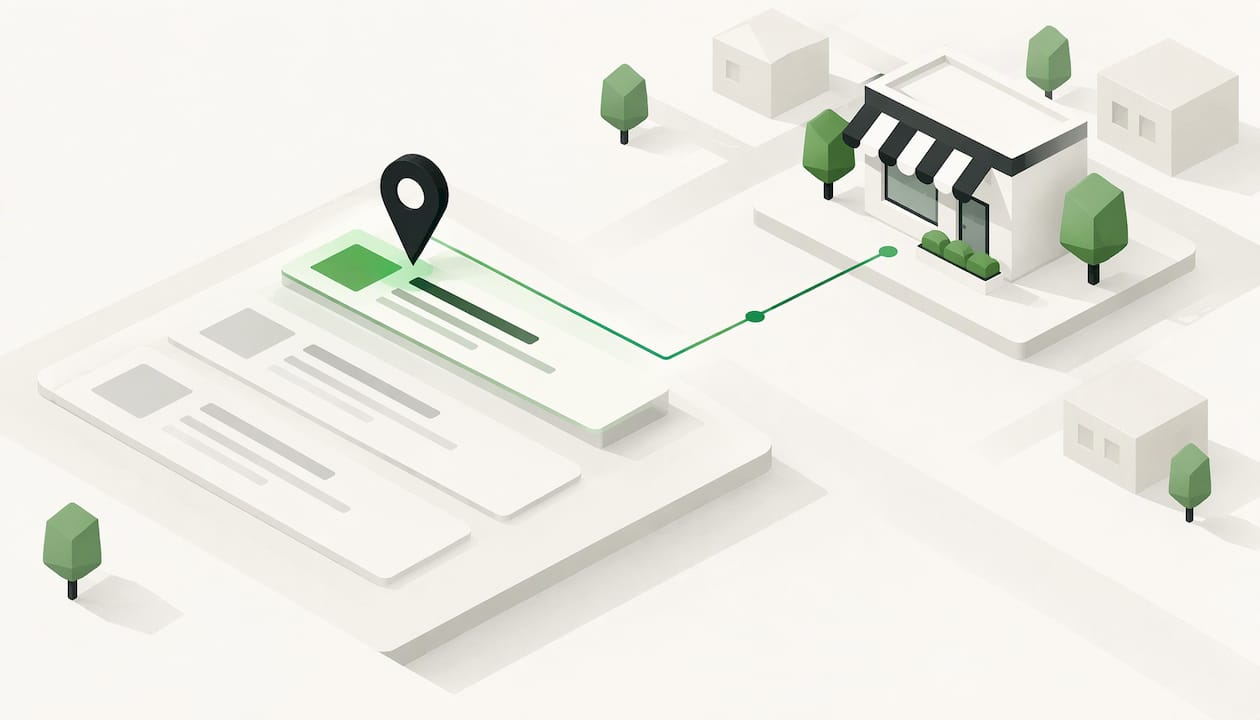
You get on the first page of Google by making sure Google can find your site, claiming and completing your Google Business Profile, building one focused page for each service and town you cover, and earning reviews and trust over time. Paying for ads will not move you up the organic results. For a local trade or service business, the fastest realistic win is usually the map results, not the ten blue links.
This guide is written for owners in markets like Roanoke, where a handful of competitors fight over the same searches. It is a step-by-step plan, in the order we would do it.
TL;DR
- Page one has three zones: ads, the map pack, and organic results. Local businesses usually win fastest in the map pack.
- Claim and fully complete your Google Business Profile first. Google's local ranking leans on relevance, distance and popularity.
- Build one page per service, with the town in it, instead of one page that tries to cover everything.
- Speed, mobile layout and real reviews are what keep you there once you arrive.
- Expect weeks, not days. Ads can't buy an organic ranking.
Table of Contents
- What "first page" actually means for a local business
- Step 1: Make sure Google can find your site
- Step 2: Claim and complete your Google Business Profile
- Step 3: Build one page for each service and town
- Step 4: Fix speed and mobile experience
- Step 5: Write for people, show you are the real thing
- Can you pay your way onto page one?
- How long does it take?
- How to track whether it's working
- Outranking the big names in your area
- Our perspective
- Want us to build it for you?
- FAQ
- Sources
What "first page" actually means for a local business
When a homeowner types "roof repair Roanoke" or "plumber near me," the first page is not one list. It has zones, and each one works differently.
| Zone | How you get in | Cost |
|---|---|---|
| Paid ads | Bid in Google's ad system | Pay per click |
| Map pack (local results) | Claim and optimize a Business Profile, collect reviews | Free to claim |
| Organic results | A site Google can crawl, with pages that match what people search | Time and effort |
Google's own help pages say local results are based mainly on relevance, distance and prominence, and that complete, accurate information makes a business more likely to show up. Distance is the one you can't change. Relevance and prominence are where you win.
That is why we tell contractors to stop asking "how do I rank for plumber?" and start asking "how do I show up for the exact job, in the exact area, where someone is ready to call?"
Step 1: Make sure Google can find your site
Before ranking, you need to be in Google's index. Google says it finds sites automatically, and in most cases you only need to publish. Still, check.
- Type
site:yourdomain.cominto Google. If pages come up, you are indexed. If nothing does, you have a discovery problem. - Verify your site in Google Search Console. Google's own guidance says the first step in establishing your website as your official presence is verifying ownership there.
- Check the Page indexing report for errors, and consider submitting a sitemap. Google's documentation on using Search Console says a sitemap might speed up discovery.
- Make sure your homepage is indexed. Google recommends this because it crawls onward from the homepage to your other pages.
Two honest limits. Google says it can't promise when or whether a URL will be crawled or indexed, and a sitemap doesn't guarantee indexing or boost your ranking. Also, being indexed is not the same as ranking. The URL Inspection tool docs note that a page being on Google doesn't guarantee it appears in search results.
If your site is live and still invisible, our guide on why your business isn't showing on Google walks through the usual causes.
Step 2: Claim and complete your Google Business Profile
For most trades, this is the highest-return hour you will spend. Claiming your Business Profile lets you manage how your business appears on Google Search and Maps.
Fill out everything:
- Your exact business name, with no keyword stuffing
- Primary category, plus secondary categories that match real services
- Service area or address, phone number and hours
- A services list with plain descriptions
- Real photos of your trucks, crews and finished jobs
- A link to the right page on your site
Google states that more reviews and positive ratings can improve local ranking. That makes your review process part of your ranking work, not an afterthought.
Keep your name, address and phone number identical everywhere they appear. G2's small business SEO guide explains that consistent citations help Google trust that you are a real business, and inconsistent ones can hurt.

We do this setup for clients as a flat-fee job: Google Business Profile setup is $395 one-off.
Step 3: Build one page for each service and town
This is where most contractor sites stall. One page titled "Our Services" cannot rank for ten different searches.
The approach that works: one page per service, each aimed at one focus keyword. Search Engine Land's guidance on service pages says to create an individual long-form page for each service and to include location for local businesses. It recommends placing the focus keyword in the title and H1, meta description, an H2, the first paragraph and the URL.
UC Davis's web team gives the same logic from an academic angle: target a few competitive phrases with your strongest pages, and split out pages for narrower, less competitive terms. They also suggest keeping a simple keyword map with primary and secondary terms per page.
Here is a map a Roanoke HVAC company might use:
| Page | Focus search | Goal |
|---|---|---|
| /furnace-repair-roanoke | furnace repair Roanoke VA | Emergency calls |
| /ac-installation-roanoke | AC installation Roanoke | High-value quotes |
| /heat-pump-replacement-salem | heat pump replacement Salem VA | Nearby town coverage |
Before you commit to a keyword, search it yourself. If the top results are local service pages with phone numbers and pricing cues, a service page is the right format. If they are how-to articles, a hard-sell page will struggle.
Each page should do three jobs: say what you do, prove you do it well, and make the next step obvious. Our guide on which pages a local conversion website needs lays out the full set.
Need more pages later? Extra service pages are $250 one-off per page.
Step 4: Fix speed and mobile experience
Most of your customers are on a phone, often in a hurry. G2 notes that page speed is a significant ranking factor and that mobile users make up more than 50% of Google searches.
A short checklist:
- Your phone number sits at the top of the page and is tap-to-call
- The page loads fast on cellular data, not just office wifi
- Text is readable without pinching and zooming
- Buttons are big enough for a thumb
- Forms ask for the minimum: name, number, what's wrong
Speed isn't only about rankings. A slow page loses the visitor before they ever see your number. We wrote about this in the 10-second bounce threshold for local service websites, and about the path from search to booking in the friction-free funnel.
Step 5: Write for people, show you are the real thing
Google's guidance on helpful, reliable, people-first content asks you to write for people first and show first-hand experience and depth. It also flags content made mainly to attract search visits, or mass-produced with little effort, as a warning sign.
For a contractor, first-hand experience is easy to show if you bother to:
- Describe a real job: the problem, what you found, what it cost, how long it took
- Name the neighborhoods and towns you work in
- Show before and after photos with short captions
- Put licenses, insurance and years in business where visitors can see them
- Answer the three questions customers always ask before they call
Trust also comes from your reputation off your site. Our posts on improving your online reputation and our free review QR code generator make it easier to ask every happy customer for a review at the end of the job. A review system setup is $250 one-off if you want it built for you.
Can you pay your way onto page one?
Only onto the paid part of it. Google says advertising programs are independent of search results: participating doesn't affect inclusion or ranking, and payment doesn't improve rankings for particular keywords.
Ads can still make sense for a trade that needs calls this month while the organic work builds. Just treat them as a separate channel with a separate budget. The same goes for anyone who promises a guaranteed first-page ranking. Google itself makes no such guarantee about where any site appears.
How long does it take?
Google's SEO Starter Guide says changes can take anywhere from a few hours to several months to show up, and that you should generally wait a few weeks before judging whether your work helped. Google also notes it can take a few weeks to notice a new site.
A realistic rhythm for a local business:
- Week 1: Verify Search Console, claim and complete the Business Profile, fix the basics on the site.
- Weeks 2 to 4: Publish your core service pages. Start asking for reviews on every job.
- Months 2 to 3: Add pages for secondary services and nearby towns. Check what's getting impressions.
- Ongoing: Keep adding reviews, photos and pages. Fix what the data shows.
We won't promise you a position by a date. Nobody honest can. What you can control is doing the right work in the right order and measuring it.
How to track whether it's working
Rankings are a vanity number if the phone doesn't ring. Track these instead:
- Search Console performance: which searches show your pages, and which get clicks
- Business Profile insights: calls, direction requests and website clicks
- Call count: how many calls came in each week, and how many were real jobs
- Review velocity: how many new reviews per month, and your average rating
- Booked jobs by source: ask every caller how they found you
If calls come in and you miss them, you leak the gains. A simple system for follow-up, like the one in our CRM guide, keeps good leads from going cold. More on turning visits into calls in how to get more calls from your website.
Outranking the big names in your area
You don't need to beat national brands everywhere. You need to beat them for your services in your service area. Smaller teams do this with sharper local pages, a complete profile and a steady flow of recent reviews. If that's your situation, read how small service teams can outrank big local competitors and the three-step fix for a business not ranking in its service area. Our roundup of local SEO tools for Roanoke small businesses covers what to use for tracking.
Our perspective
Most contractors we talk to have the same story. They paid for a pretty website or bought shared leads, and neither gave them a steady phone. The site looked fine. It just wasn't built to be found or to get a call.
Our view is simple. A website for a trade business is a sales hotline, not a brochure. It should load fast on a phone, say clearly what you do and where, prove you're the real thing, and put your number one tap away.
That's why our builds start from research into what your customers actually type into Google in your market, then get organized into service and area pages, a complete Business Profile and a review process. Everything we build is meant to bring in direct calls, not leads you share with three competitors.
You also own the assets. The domain, the site and the profile are yours. Ongoing support is something you choose, not something you're locked into. And we show you a live demo before any payment is required, so you see what you're getting first.
devbodhi
Want us to build it for you?
If you'd rather run jobs than run SEO, we build and manage this for Roanoke-area service businesses. Our Core build is $2,997 one-off. A website built to get calls is $2,250 one-off. If you want ongoing optimization and content, Pro is $597 per month and Max is $1,697 per month. You can also add pieces: domain, email and DNS set up or moved is $350 one-off, and hosting, backups, monitoring and small edits are $99 per month.

See exactly what's included on our Roanoke web design page, or start from devbodhi.pro and ask for the demo. For a sense of how pricing compares across the market, read how much a small business website should cost.
FAQ
How do I get my website on Google's first page quickly?
There is no honest shortcut for organic results. The fastest local route is a complete, verified Google Business Profile plus a handful of focused service pages and fresh reviews. Google says changes can take hours to months, so give it a few weeks before judging.
Why isn't my website showing when I search my business name?
First run site:yourdomain.com to see whether Google has indexed you. Google lists reasons a site may be missing, including being new, not linked from other sites, or having crawl errors. Search Console shows which applies.
Do I need to pay for Google Ads to be on page one?
No, not for organic or map results. Google says paying for ads doesn't improve organic rankings. Ads give you a paid spot above or beside the results, which is a separate channel from the work above.
Is the map pack or the regular results better for a contractor?
For most local searches with buying intent, the map pack gets the eyes first, and it runs on your Business Profile, reviews and proximity. Regular results reward strong service pages. Work on both, but start with the profile because it's free to claim and quick to complete.
Sources
- How to Get Information on Google, Google Search Central
- Add Business Details to Google, Google Search Central
- How To Use Search Console, Google Search Central
- Page indexing report, Search Console Help
- FAQ: Google Search Crawling and Indexing
- URL Inspection tool, Search Console Help
- Tips to improve your local ranking on Google, Business Profile Help
- Small Business SEO Guide, G2
- How to create service pages that rank and convert, Search Engine Land
- Applying Keyword Research, UC Davis
- Creating Helpful, Reliable, People-First Content, Google Search Central
- FAQ: Site Position in Google Search, Google Search Central
- SEO Starter Guide: The Basics, Google Search Central